Tips & Advice
Winter Car Storage & Protection: California Owner's Guide

Blackout Team· Window Tinting Experts
·11 min read

Complete California winter storage guide for collector and performance cars. Pre-storage prep, protection, monthly care, and spring recommissioning tips.
Winter Car Storage & Protection: California Owner's Guide
California "winter" may not involve snow, but it brings its own challenges—months of rain, humidity, reduced driving for some vehicles, and conditions that can damage an unprotected car. Whether you're storing a weekend Porsche or protecting your daily driver through the wet months, this guide covers everything you need to know.
At Blackout Window Tinting, we see the aftermath every spring: water spots, contamination bonding, paint damage, and interior issues that could have been prevented. Proper winter preparation saves thousands in restoration costs.
Understanding California Winter
What "Winter" Means Here
| Challenge | Bay Area Reality | Impact on Vehicles |
|---|---|---|
| Rainy season | Nov-April heavy rain | Water spots, contamination |
| Humidity | 70-90% some days | Mold, mildew, corrosion |
| Temperature swings | 35-65°F daily changes | Condensation issues |
| Reduced driving | Less sunshine motivation | Flat spots, battery drain |
| Road grime | Construction, mud, debris | Paint contamination |
Two Categories of Winter Care
Stored Vehicles:
- Weekend/track cars not driven in rain
- Collector vehicles
- Convertibles kept dry
- Seasonal cars
Daily Drivers:
- Commuter vehicles in rain
- Family cars
- Work trucks
- Year-round use vehicles
This guide covers both—with separate recommendations for each situation.
Pre-Storage Protection Checklist
For Vehicles Going Into Storage
Timing: Complete 2-4 weeks before storage begins
Step 1: Professional Detailing
Before storage, your vehicle needs a thorough cleaning:
| Task | Why | DIY or Pro? |
|---|---|---|
| Full exterior wash | Remove surface contamination | DIY possible |
| Clay bar treatment | Remove embedded particles | Pro recommended |
| Paint correction | Remove swirls before they worsen | Pro only |
| Ceramic coating | Protect during storage | Pro only |
| Interior deep clean | Prevent mold, odors | DIY or Pro |
| Engine bay clean | Remove debris that traps moisture | Pro recommended |
Why clean before storage? Contaminants continue damaging paint even in storage. Clean surfaces stay protected; dirty surfaces degrade.
Step 2: Apply Protection
Ceramic Coating (Highly Recommended)
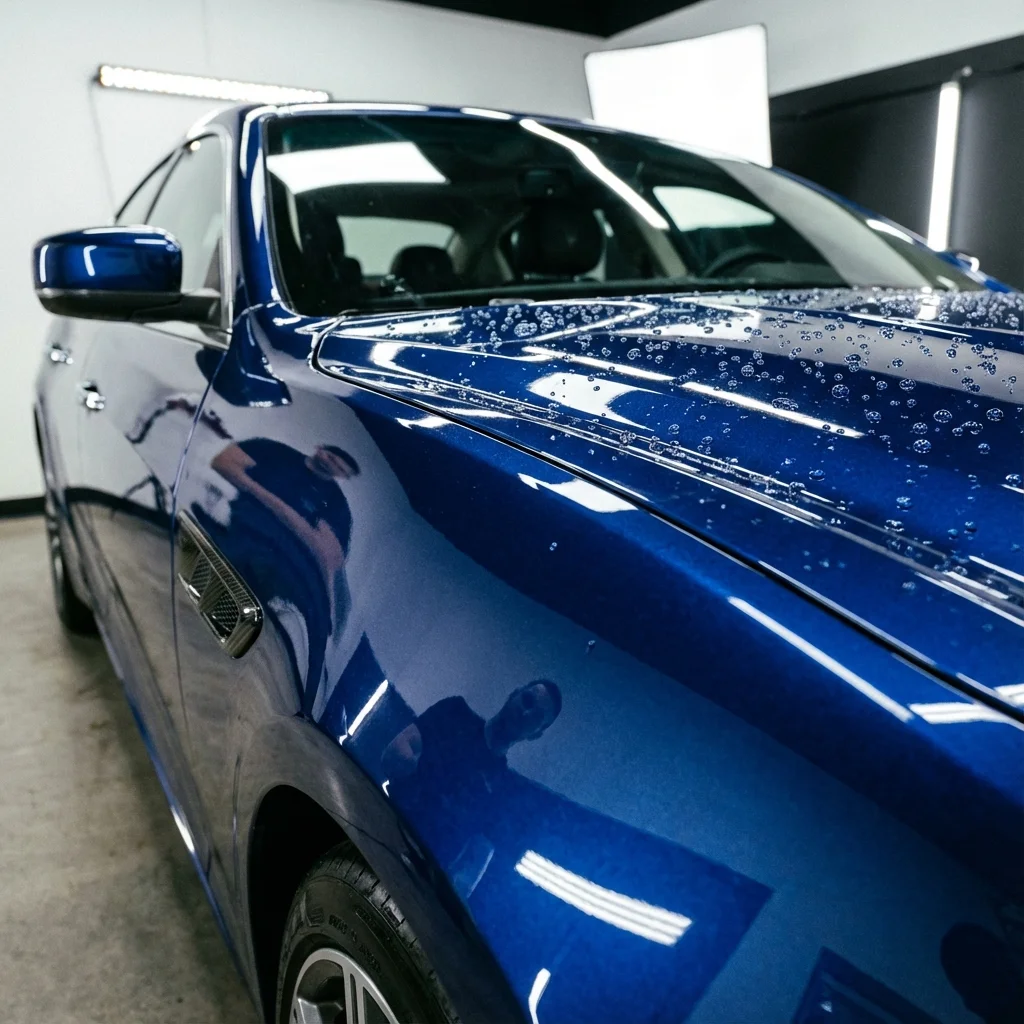
Ceramic coating is the single best storage protection:
- Creates impermeable barrier against moisture
- Prevents dust and debris bonding during storage
- Makes spring cleaning effortless
- Protects against humidity-related issues
- Lasts 2-5 years with proper maintenance
PPF on High-Risk Areas
Even in storage, vehicles face risks:
- Garage debris from foot traffic
- Accidental bumps from other stored items
- Pest damage (mice chewing on paint edges)
- Paint Protection Film guards against all of these
Window Tint Benefits During Storage
Ceramic window tint protects during storage:
- UV protection for interior (even garage lighting emits UV)
- Reduces interior heat cycling on sunny days
- Privacy if stored in shared spaces
- Prevents sun damage to leather and dashboard
Step 3: Mechanical Preparation
| System | Storage Prep | Why |
|---|---|---|
| Fuel | Fill tank + stabilizer | Prevents tank corrosion, fuel degradation |
| Oil | Fresh oil before storage | Old oil contains contaminants |
| Battery | Tender/maintainer connected | Prevents dead battery, sulfation |
| Tires | Inflate to max pressure | Reduces flat-spotting |
| Brakes | Avoid setting parking brake | Prevents brake pad sticking |
| Fluids | Top off all reservoirs | Prevents corrosion in lines |
Step 4: Interior Preparation
| Task | Purpose | How |
|---|---|---|
| Remove valuables | Security + reduce temptation | Take home |
| Clean all surfaces | Prevent mold growth | Interior detail |
| Add desiccant | Absorb moisture | Rechargeable packs |
| Crack windows slightly | Air circulation | 1/4" gap if covered/garaged |
| Leather conditioning | Prevent drying | Clean then condition |
Storage Options Compared
Covered vs. Outdoor Storage
| Factor | Indoor Garage | Covered Outdoor | Uncovered Outdoor |
|---|---|---|---|
| Cost | Own garage: Free | $100-$300/mo | $50-$150/mo |
| Weather protection | Excellent | Good | Poor |
| Temperature stability | Good | Moderate | None |
| Security | Best | Variable | Lowest |
| Accessibility | Best | Good | Best |
| Recommended for | Collector cars | Weekend cars | Trucks, beaters |
Climate-Controlled Storage
For high-value vehicles:
Benefits:
- Constant temperature (55-65°F ideal)
- Humidity control (40-50% ideal)
- Prevents rubber/leather drying
- Eliminates condensation cycling
- Protects electronics from moisture
When it's worth it:
- Vehicles worth $100,000+
- Irreplaceable classics
- Concours condition vehicles
- Extended storage (6+ months)
Cost: $300-$800/month depending on location
Garage Storage Best Practices
If storing at home in your garage:
| Practice | Why | How |
|---|---|---|
| Clean garage first | Prevent dust contamination | Sweep, remove chemicals |
| Off concrete | Prevent moisture wicking | Tire mats or jack stands |
| Away from doors | Reduce temperature swings | Back of garage |
| Battery tender access | Easy connection | Run cord neatly to outlet |
| Cover appropriately | Protect from dust | Breathable cover, not plastic |
Monthly Storage Care Routine
The Monthly Checklist
Even in storage, vehicles need attention:
Every Month:
| Task | Time Needed | Purpose |
|---|---|---|
| Visual inspection | 10 min | Check for issues |
| Battery check | 2 min | Verify tender working |
| Pest check | 5 min | Look for rodent signs |
| Tire rotation (in place) | 15 min | Move slightly, prevents flat spots |
| Start and run | 20 min | Optional—see below |
To Start or Not to Start?
Controversial topic: Should you start a stored car monthly?
Arguments for starting:
- Circulates fluids
- Exercises seals
- Charges battery (if not on tender)
- Identifies issues early
Arguments against:
- Creates condensation in exhaust (if not fully warmed)
- Uses fuel with stabilizer
- Can attract pest attention
- Unnecessary with proper prep
Our recommendation:
- If properly prepped with tender: No need to start monthly
- If no tender available: Start monthly and drive briefly
- If starting: Run until fully at operating temperature (10+ minutes)
Temperature and Humidity Monitoring
For valuable vehicles, monitor conditions:
Simple approach: Digital thermometer/hygrometer ($15)
Ideal ranges:
- Temperature: 40-70°F
- Humidity: 40-60%
Warning signs:
- Visible condensation anywhere
- Musty smell developing
- Humidity above 70% consistently
Spring Recommissioning Checklist
2-3 Weeks Before Driving Season
Begin preparation before you want to drive:
Step 1: Systems Check
| System | Check | Action if Needed |
|---|---|---|
| Battery | Voltage + charge | Replace if below 12.4V |
| Tires | Pressure + condition | Inflate, inspect for flat spots |
| Brakes | Rotor rust | Light drive, they'll clean up |
| Fluids | Levels + condition | Top off or flush if degraded |
| Belts | Cracks, tension | Replace if questionable |
| Filters | Air filter especially | Replace if stored 6+ months |
Step 2: Exterior Revival
| Task | Purpose | Method |
|---|---|---|
| Rinse thoroughly | Remove storage dust | Pressure wash safe distance |
| Wash properly | Clean without scratching | Two-bucket, pH-neutral soap |
| Inspect coating | Verify protection intact | Water bead test |
| Detail wheels | Clean brake dust | Appropriate wheel cleaner |
| Check PPF | Verify no lifting | Visual inspection of edges |
If ceramic coated before storage: A quick wash is usually all that's needed.
Step 3: Interior Refresh
| Task | Purpose | Method |
|---|---|---|
| Remove desiccant | No longer needed | Store for next winter |
| Vacuum thoroughly | Remove any debris | Include seat crevices |
| Wipe all surfaces | Dust removal | Microfiber + interior cleaner |
| Condition leather | Restore moisture | Non-greasy conditioner |
| Clean glass | Clear vision | Interior glass cleaner |
| Replace air freshener | Fresh scent | Moderate product |
Step 4: First Drive
Your first drive after storage matters:
- Short trip first — Stay within 10 miles
- Listen carefully — Note any unusual sounds
- Check all functions — Lights, signals, wipers
- Easy acceleration — Let engine fully warm
- Test brakes gently — Will feel rough initially
- Inspect tires — Look for vibration indicating flat spots
Daily Driver Winter Protection
For Cars Driven Through Rainy Season
If you're not storing your vehicle, protection is even more important:
Pre-Winter Protection Package
Minimum recommendations:
| Protection | Why Essential | Investment |
|---|---|---|
| Ceramic coating | Sheds water, prevents bonding | $500-$1,500 |
| Glass coating | Visibility in rain | $100-$200 |
| Wheel coating | Brake dust resistance | $150-$300 |
Full winter package:
| Protection | Benefit | Investment |
|---|---|---|
| Full ceramic | Complete paint protection | $800-$1,500 |
| PPF on front | Debris from wet roads | $1,200-$2,500 |
| Headlight protection | Maintain visibility | $150-$250 |
| Ceramic tint | Glare reduction | $350-$800 |
Total: $2,500-$5,000 for comprehensive protection
Monthly Winter Maintenance
Even with protection, maintenance matters:
| Task | Frequency | Why |
|---|---|---|
| Quick wash | Monthly minimum | Prevent buildup |
| Wheel cleaning | Monthly | Brake dust bonds in wet |
| Glass treatment | As needed | Maintain visibility |
| Interior cleaning | Monthly | Wet shoes track in debris |
Read our Winter Car Care Guide →
The "Rain Excuse" Trap
Don't skip washing because "it's just going to rain again."
This mindset causes more paint damage than anything else:
- Rain doesn't clean—it adds contamination
- Debris bonds more tightly when repeatedly wet/dried
- Spring correction is expensive: $400-$800+
Solution: Quick maintenance wash between storms ($20 self-serve or $50 touchless)
Special Considerations
Convertibles
Soft top vehicles need extra attention:
| Concern | Prevention | Action |
|---|---|---|
| Top condition | Keep clean + protected | Fabric sealant treatment |
| Top operation | Exercised occasionally | Open/close monthly |
| Interior moisture | Cracks if top ages | Check seals, replace if needed |
| Tonneau cover use | Moisture trap | Don't use if storing long-term |
EVs in Storage
Electric vehicles have specific needs:
| Concern | EV Solution |
|---|---|
| Battery level | Store at 50-70% charge |
| 12V battery | Still needs tender |
| Software updates | Keep connected if possible |
| Scheduled charging | Set to maintain level |
| Tire flat spots | Same concern as ICE vehicles |
Classics and Collectibles
High-value vintage vehicles:
| Extra Step | Why |
|---|---|
| Fuel stabilizer + filter | Old carbureted vehicles especially |
| Coolant check | Old coolant can corrode |
| Rubber conditioning | Old rubber dries out |
| Document condition | Photos for insurance |
| Premium storage cover | Fitted, breathable, flannel-lined |
Common Winter Storage Mistakes
Mistake 1: Plastic Covers
Problem: Plastic tarps trap moisture, creating condensation that damages paint.
Solution: Breathable car covers only—quality cotton, flannel-lined, or purpose-built storage covers.
Mistake 2: Ignoring Pests
Problem: Mice love warm engine bays and stored vehicles.
Signs: Droppings, chewed wiring, nest material.
Prevention:
- Mothballs or peppermint oil around vehicle
- Steel wool in exhaust pipes
- Hood left slightly open
- Regular inspections
Mistake 3: Skipping Pre-Storage Detail
Problem: Storing a dirty car means contamination bonds during storage.
Reality: Cleaning in spring costs more than cleaning before storage.
Mistake 4: "Airtight" Storage
Problem: Completely sealing a vehicle traps moisture.
Solution: Slight air circulation prevents condensation buildup.
Mistake 5: No Protection at All
Problem: Assuming garage = protected.
Reality: Dust, humidity, temperature changes, and time still damage unprotected paint.
Professional Winter Services
Our Winter Prep Package
At Blackout Window Tinting, we offer complete winter preparation:
Storage Prep Package:
- Full exterior detail with clay bar
- Paint correction (if needed)
- Ceramic coating application
- Interior deep clean and protection
- Engine bay cleaning
- Investment: $800-$1,800 (depending on vehicle condition)
Winter Driver Package:
- Ceramic coating (exterior + wheels)
- Glass ceramic coating
- Ceramic window tint (optional add-on)
- Investment: $1,000-$2,500
Spring Recommission Service:
- Full wash and inspection
- Coating maintenance/boost
- Interior refresh
- Systems check
- Investment: $200-$400
Frequently Asked Questions
How long can I store my car without driving it?
With proper preparation (battery tender, fuel stabilizer, correct tire pressure), most vehicles can safely store 6-12 months. EVs can store longer since they don't have fuel system concerns. Classic cars with carburetors are more sensitive—3-6 months maximum without running is typical advice.
Should I store my car on jack stands?
For storage over 60 days, jack stands prevent flat spotting. Support the vehicle at the frame rails or designated jack points. This also allows tires to be deflated slightly, reducing sidewall stress. For shorter storage, high tire pressure (max sidewall rating) and monthly rotation is sufficient.
Will ceramic coating protect my car in storage?
Absolutely—it's ideal for stored vehicles. Ceramic coating prevents dust bonding, protects against humidity, and makes recommissioning much easier. We recommend coating before storage rather than after. Even in a garage, dust and moisture affect uncoated paint over time.
How do I prevent water spots during rainy season?
Ceramic coating is the best prevention. Coated vehicles shed water and resist spot formation. For daily drivers without coating, dry your vehicle promptly after rain or wash, and don't park under trees. Water spots form when mineral-laden water evaporates on paint—coating prevents water from sitting.
Is it worth detailing before storage if I'll detail again in spring?
Yes—pre-storage detailing is actually more important. Contamination left on paint during storage bonds more deeply over time. A clean, protected surface emerges from storage needing only a light wash. A dirty surface emerges needing correction. The math: $200 pre-storage detail vs. $500+ spring correction.
How much does proper winter storage cost?
For a typical performance car stored in your garage for 4-6 months:
- Pre-storage detail: $200-$400
- Ceramic coating: $500-$1,200
- Battery tender: $30-$80
- Car cover: $100-$400
- Fuel stabilizer: $15
- Monthly attention: Your time
Total investment: $850-$2,000 initially, much less in subsequent years (coating lasts multiple seasons).
Should I store my car with a full tank or empty?
Full tank with fuel stabilizer. Empty tanks allow condensation, which causes rust in steel tanks and water contamination. Full tanks with quality stabilizer (like Sta-Bil) keep fuel fresh for 12+ months. Add stabilizer before the last drive so it circulates fully.
What if my garage isn't climate-controlled?
Most home garages work fine for storage:
- Use desiccant packs inside the vehicle
- Crack windows slightly for circulation
- Monitor humidity with a cheap sensor
- Choose breathable cover over plastic
- Consider battery tender with humidity-sensing shutoff
The main enemies are moisture and temperature cycling. A garage eliminates direct rain and reduces cycling—that's usually enough for 6-month storage.
Get Winter-Ready at Blackout
Protect your investment before the weather turns.
Why Choose Us for Winter Prep
✅ 33+ years experience since 1993 ✅ Complete protection packages — detail through coating ✅ Premium products only — coatings and films that last ✅ Indoor facility — work regardless of weather ✅ Bay Area expertise — we know California conditions
Schedule Your Winter Prep
📞 Call us: 408-848-8468
📍 Visit us: 610 Holloway Rd, Gilroy (behind Target)
Book now for October-November availability — our schedule fills quickly as rain approaches.
Related Articles
- Winter Car Care Bay Area — Daily driver guide
- Ceramic Coating Complete Guide — Pricing and options
- Best Ceramic Coatings Bay Area — Product comparison
- Spring Detailing Checklist — Recommissioning guide
Visit the Experts in Gilroy
Blackout Window Tinting is the Bay Area's premier choice for premium auto protection. Based in Gilroy at 610 Holloway Rd (behind Target), we've served the South County and Silicon Valley area for over 33 years. Whether you're coming from Morgan Hill, Hollister, or anywhere else in the Bay Area, we're your trusted local source for professional window tint, PPF, and ceramic coating.
📞 Questions? Call us at 408-848-8468 or get a free quote online.
33+ years
The team at Blackout Window Tinting has been serving the Bay Area since 1993, providing premium window tinting and vehicle protection services.
Window TintingPPFCeramic CoatingVehicle Wraps